


How often do you give in just because you are afraid of saying NO?
Blue negotiators are likely to do it more often.
About negotiation styles
Over our lifetime, we develop attitudes and beliefs which both consciously and unconsciously influence the way we behave in negotiations. These underlying beliefs mould our negotiating philosophy, which, in turn, creates our underlying or reflex negotiation style.
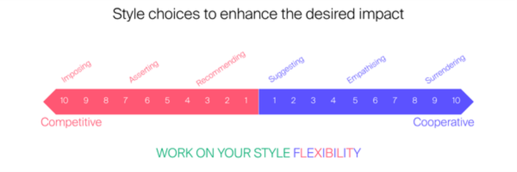
Negotiation and influencing behaviours take many forms, which may be represented as a range along a spectrum. We label the spectrum from highly competitive red 10 (R10) to highly cooperative blue 10 (B10).
At the red end of the spectrum, negotiators may be characterised as being hostile, aggressive, dominating, or pushy. At the blue end are negotiators who sometimes seem so overly friendly, compliant and accommodating that they almost seem to be working against their best interests. Towards the middle are negotiators who may be seen as assertive (R5) or supportive (B5).
There is no correct style. Skilled negotiators understand their underlying negotiation philosophy and how it influences their approach. They purposefully select the most appropriate style to meet the specific negotiation circumstances.
What is your preferred negotiation style?
1. Perception of power is crucial when negotiating. As a negotiation evolves, you may intentionally change your style choice in either direction. Indeed, your capacity to manage your behaviour by using the whole style range is often the key to success.
Skilled negotiators practise purposeful style flexibility.
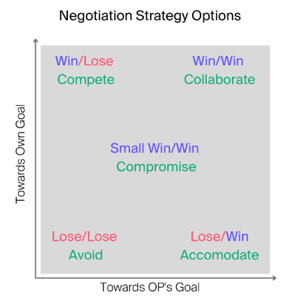
Win-win / win-lose negotiation strategies
The WIN-WIN / WIN-LOSE concept popularised 50 years ago by the Harvard Negotiation Project (Getting to Yes book by Roger Fischer and William Ury) could be bridged to the blue and red colours.
Why not illustrate WIN-WIN as blue-blue and WIN-LOSE as blue-red?
Blue-blue fosters collaboration and may lead to value creation for both parties. Understanding each other’s needs may help uncover asymmetries and places where potential value is hidden. Negotiators looking for a long-term relationship do not fight to share the pie; their ambition is to enlarge the pie, allowing both parties to grow and WIN.
Blue-red fosters competition. One side is willing to WIN, even at the expense of the other. Long-term is not the priority. It’s about short-term gain, beating the other, sharing the pie in a way that I get more than you.
Is WIN-WIN better than WIN-LOSE? Are blue negotiators achieving more? It depends.
There are times when a great WIN-WIN is possible. There are times when circumstances only make a WIN-LOSE possible. And there are times when you must play the WIN-LOSE, LOSE-WIN to then, hopefully, go together to a WIN-WIN.
Style flexibility will help you navigate the different situations.
2.
Style flexibility and blue negotiators
Are you able to play the full spectrum from B10 to R10?
Or are you a blue negotiator struggling to flex far in the red? If this is the case, let’s start with introspection.
Bring to your mind a situation in which you gave away more than you wanted. What happened in that exact moment when you made a concession you did not plan to make? The moment you made a conscious decision to let the other party get more of what they should have gotten. What happened?
Maybe something quite basic… Something homo sapiens already had 300’000 years ago to preserve their identity. You may well have been the victim of an amygdala hijack (term coined by psychologist Daniel Goleman in his 1995 book, Emotional Intelligence).
The amygdala hijack is a rapid, intense physiological reaction where the brain’s emotional centre bypasses logical thought to trigger a “fight-flight-freeze” response. It involves the immediate release of stress hormones such as cortisol and adrenaline, which cause physical symptoms. Blue negotiators tend to respond in a “flight-freeze” mode.
A story from my world
At the start of the Ukraine-Russia conflict, when energy prices soared, a sales representative in the packaging sector had to negotiate a significant price increase with a key client. The client’s tactic was to threaten to move a large portion of their business elsewhere if prices were raised. The client bluffed about the existence of competition to avoid any significant price change. The sales representative, adopting
3. an overly accommodating stance by default, absorbed 65% of the energy price increase to apparently preserve his sales volumes.
Did he really negotiate well?
Has he been too blue? Has he been responding in a “flight-freeze” mode?
Practical tips to become more red
Being aware of your capability to flex your style is the starting point. To become efficient at countering red tactics, you need to learn to control your amygdala hijacks that tend to happen during stressful moments:
- Once you start feeling the chemical surge in your brain, give yourself a few seconds of silence
- Take a deep breath
- Silently label your emotion, like “I am feeling angry”.
Now you can plan the most appropriate way to respond, using one of the following options to play a redder game:
- Move from discovery questions to assertive questions
- Go from questions to statements
- Use fewer words
- Keep silent
- Interrupt
- Use a red vocabulary (a challenge is becoming a problem)
- Change the tonality of your voice
- Make a threat
- Change your body language
- Interrupt the meeting / quit the meeting
- Put an ultimatum
- Use time and place
- Etc.
Practice to gain confidence
Style flexibility is a great tool to improve your negotiating power and help you reach your desired outcomes. Practice at work. Practice in your private life. Your style flexibility will be extended.
Blue is good… so is red…
Andy Marko
